Nota
Music notation that sits naturally alongside written text
Nota
Nota brings engraved music notation into LaTeX documents, allowing scores to sit naturally alongside written text instead of feeling pasted onto the page.
It is intended for articles, teaching material, musicological writing, critical editions, and other publications where words and music share the same space. When the music changes, the document can be rebuilt from the score itself, without repeatedly exporting, cropping, and replacing graphics by hand.
Nota continues to evolve. GitHub is the home for its current documentation, installation instructions, releases, and complete demonstrations.
Nota
GitHub · @manoliskyDocumentation, releases, and complete demonstrations for Nota.
In use
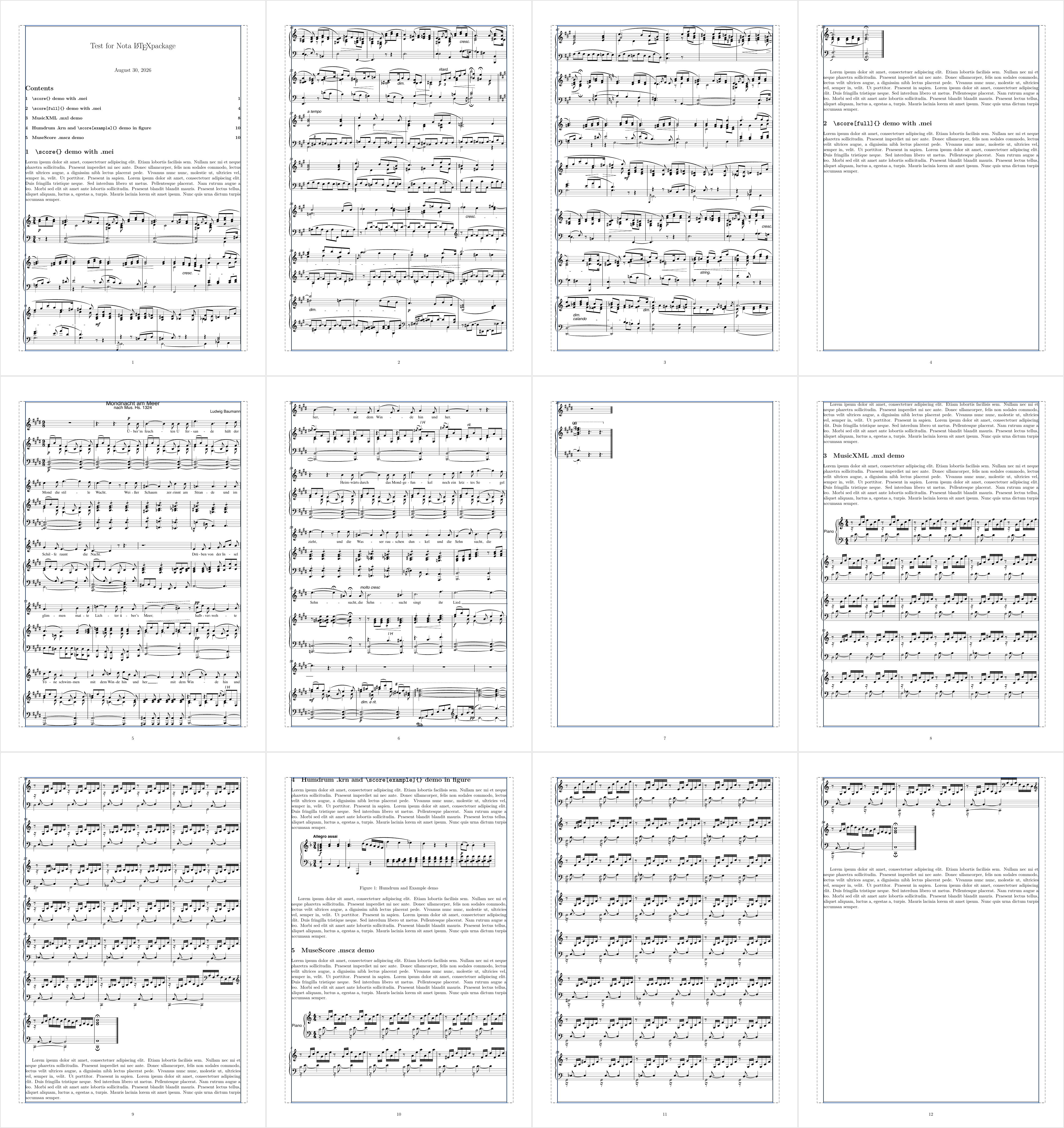
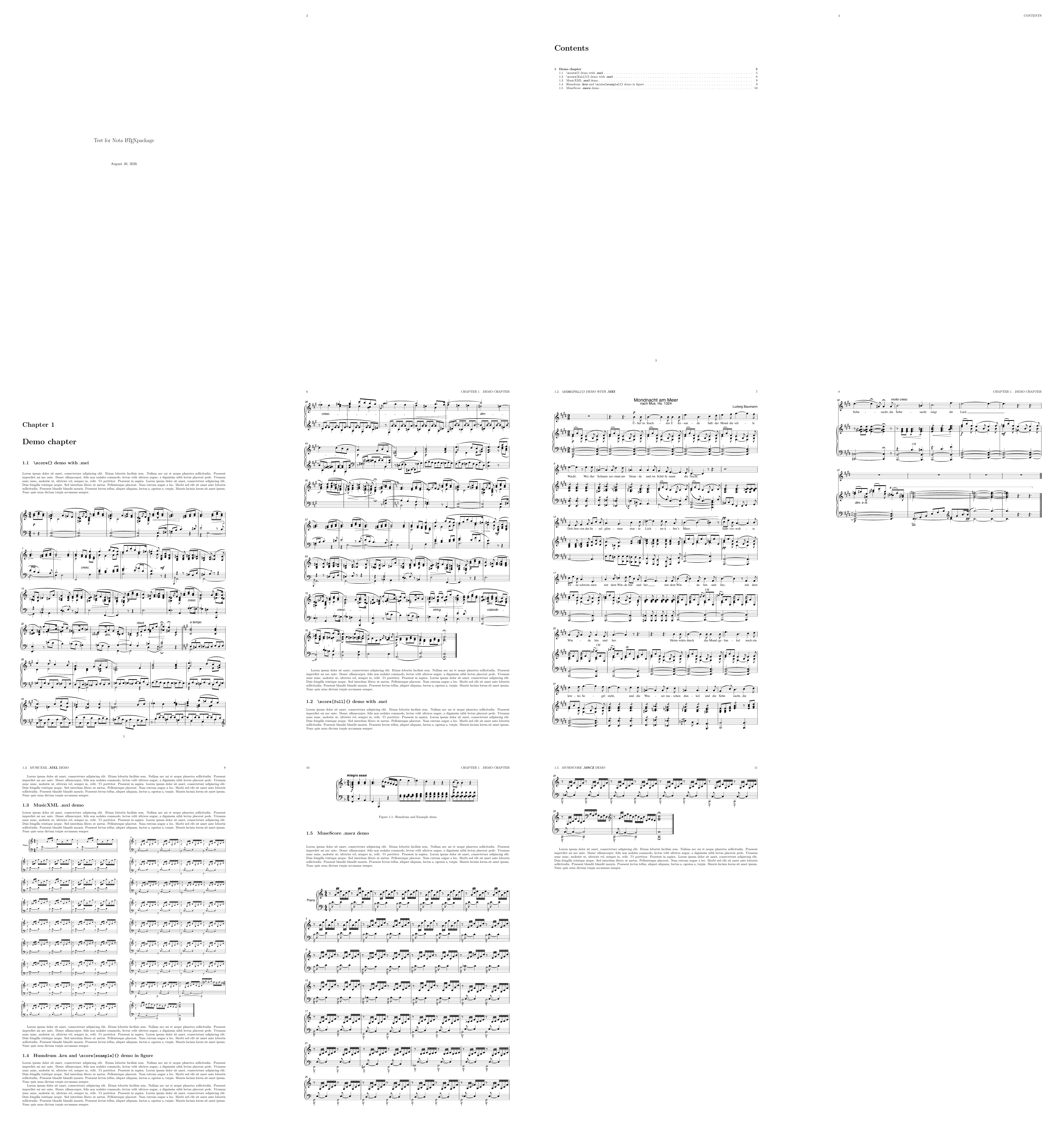
These examples show how Nota adapts music to different page sizes and layouts while keeping the notation part of the document.
Why Nota
Writing about music often means moving between two separate worlds: one tool handles the words and page design, while another handles the score. Each musical edit can lead to another export, crop, resize, and replacement, and the resulting graphic may still feel disconnected from the document around it.
Nota emerged from that repeated work. It lets the document keep control of its pages and lets the music remain a living, editable score. The aim is not simply to place music inside a document, but to make text and notation behave like parts of the same publication.
Feature overview
Nota supports in-flow notation, allowing musical systems to continue between paragraphs and across pages. Its output is aware of the page, responding to the available space, margins, and scale of the surrounding document. Scores remain editable at the source, and they can be presented as flowing systems, full pages, or compact examples. Several common notation formats are supported, while unchanged material can be reused across repeated document builds.
How it works
Nota keeps page layout and music engraving as two cooperating parts. As LaTeX lays out the document, it records the space available for each score. Nota then prepares the music for those measurements, and the following document build places the finished notation back where it belongs.
This division lets LaTeX remain responsible for text, margins, columns, and page breaks, while a dedicated music engraver concentrates on the score. The two sides exchange just enough information for the notation to feel native to the page, without asking the author to manage a folder of exported graphics.
Technologies used
Nota is built by connecting mature tools and open standards, each responsible for the work it does best:
- LaTeX — website · GitHub — shapes the writing, pages, and final publication.
- Go — website · GitHub — powers the small renderer that coordinates the work and reuses unchanged results.
- Verovio — website · GitHub — engraves the musical notation.
- SMuFL — website · GitHub — provides a shared standard for musical symbols and fonts.
- librsvg — website · GitLab — carries the engraved vector artwork into a form the final document can use.
- Music Encoding Initiative — website · GitHub — supports an open, structured way to describe music and preserve it beyond a single piece of software.
- MusicXML — website — provides an open format for exchanging digital music scores between notation tools.
- MuseScore — website · GitHub — mscore cli is used to format the scores for inclusion in the document for mscz files.